Do you have a moment to talk about wine's carbon footprint? Environmental issues can sometimes feel complicated, but when it comes to wine, you can get by with just the basics—and those famous small everyday choices. After reading this, you'll be even more informed!
Carbon footprint has been discussed for a long time. Familiar examples for many include emissions from travel and transporting goods. Practically everything in our daily lives generates some amount of emissions, so naturally wine also has a carbon footprint, which is affected by many factors. So how could you reduce your own wine carbon footprint? And preferably quite effortlessly?
To the delight of wine lovers, selections are huge these days, and sustainability increasingly tips the scales. You might even experience choice overload between the shelves. To avoid spending hours between the shelves, it's often best to start quite simply with what type of wine you like anyway.
If you want to further lighten your carbon footprint when it comes to wine, you can do it with a small everyday choice. Without sacrificing taste or compromising on quality!
Increasingly often at Alko, you'll come across shelf labels and symbols highlighted in green that indicate green values. With their help, for example, those who prefer organic production or vegans can find what they're looking for.
Among the symbols you'll also find the environmentally responsible packaging mark, and it's especially worth keeping an eye on. If you're interested in other green values, you can find an information package here.
What is environmentally responsible packaging?
It essentially means packaging that's lighter than the traditional glass bottle, and these include lightweight glass bottles, plastic bottles, cartons, bag-in-box, aluminum cans, and wine pouches.
The lighter and more recyclable the packaging, the better. The weight of the packaging has quite a significant impact on wine's carbon footprint, from production to transport. Manufacturing and transporting heavier packaging typically requires more resources than lighter packaging, and this affects the amount of emissions.
Plastic being included might surprise you, but the environmental responsibility of plastic bottles is complemented by their very high recycling rate in addition to their lightness, thanks to our deposit system.

In addition to plastic, other materials also excel in recyclability. Cartons and bag-in-box cardboard are easy to recycle in normal cardboard collection, while plastic and lightweight glass bottles can be conveniently taken to the store's bottle return. That's how it goes—when you return bottles to the store, it's like putting money in the bank!
So there you have it—an easy everyday action just by checking the packaging. And that's not all: by choosing wine in environmentally responsible packaging, you also get something lighter than a regular wine bottle to carry in your shopping bag. How nice!
What about the inner pouch of bag-in-box?
With bag-in-box wine, a question may arise about the wine pouch with a tap inside the cardboard packaging, which is typically plastic or aluminum. This is a good question, and there's a solution:
Alko store collection points accept inner pouches made of aluminum and plastic as well as plastic parts, so you can bring the pouch with you to Alko on your next visit. Wine pouches returned to stores are utilized in cement production.
And if the pouch doesn't contain aluminum, you can of course also put it and other plastic parts in plastic recycling or energy waste. (Source: Alko).
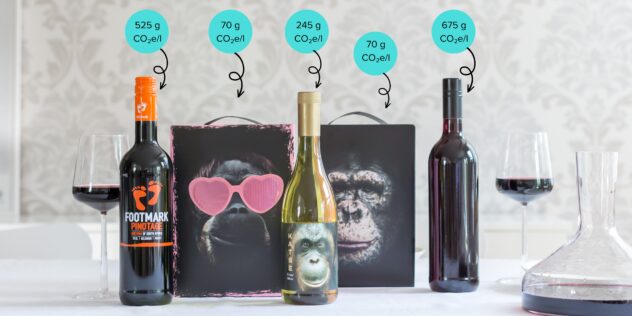
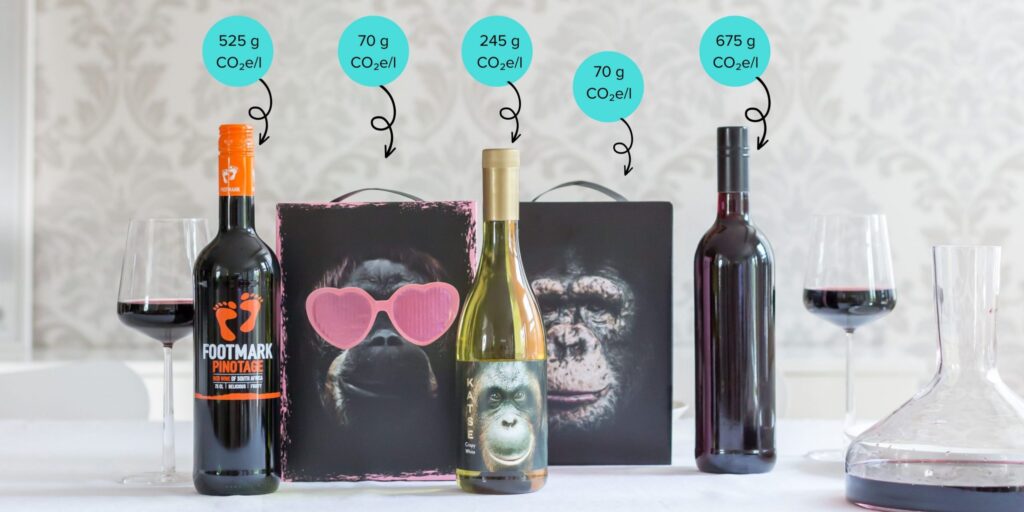
So what wines can you find in those environmentally responsible packages? Well, all kinds. In the image above you'll find a few lighter choices for your shopping bag. These look strangely familiar!
And so they are. Included are old favorites Footmark Smooth Red in a lightweight glass bottle, bag-in-box Katse Rosé and Katse La Mirada, the "monkey red wine," as well as Katse Crispy White packaged in a PET plastic bottle. And these are just a couple of options to mention!
It's wonderful that you don't have to compromise on the experience when doing a small good deed for the environment!
Wine packaging carbon footprint in numbers
Alko tells us that the typical emissions of wine packaging are as follows per liter of wine:
- Bag-in-box 70 g CO₂e/l
- Carton 85 g CO₂e/l
- Wine pouch 96 g CO₂e/l
- Aluminum can 190 g CO₂e/l
- PET plastic bottle 245 g CO₂e/l
- Lightweight glass bottle 525 g CO₂e/l
Traditional (non-lightweight glass) glass bottle emissions are the highest, about 675 g CO₂e/l. (Source: Alko).